
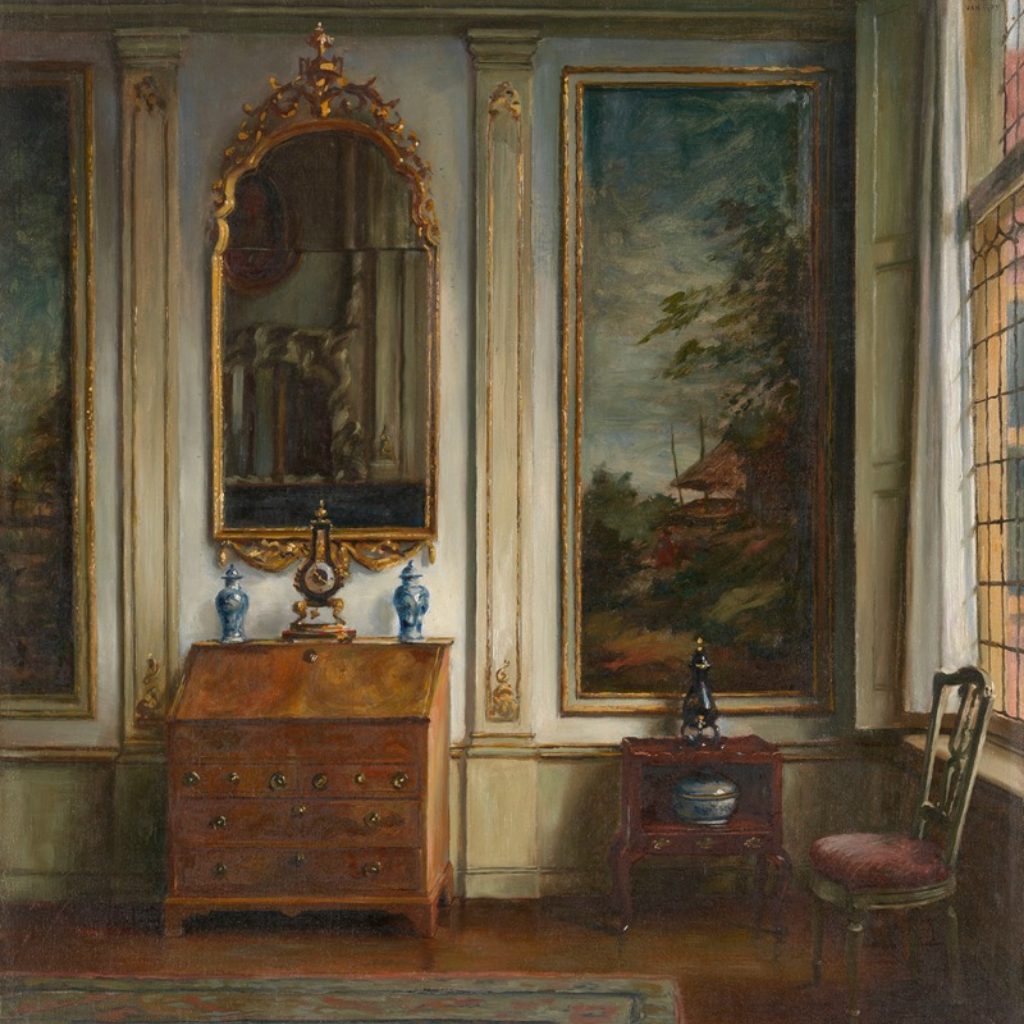
Interior of the Frans Hals Museum by Dolf Van Roy
Imagine inheriting a house on the day you become an adult. The keys arrive without a mortgage, without paperwork, without even the faint inconvenience of moving furniture through a narrow doorway. Every room is already finished. There is a sofa in the living room, pictures on the walls, plates in the cupboards, towels folded in the bathroom, and a bed made upstairs. Nothing is ugly enough to offend you. Nothing is beautiful enough to stop you in the doorway. You move in, put your coat over the back of a chair, and within a week the place has begun to feel like home.
Years pass. The sofa wears slowly in the middle. Sunlight fades one edge of the curtains. A cup leaves a pale ring on the dining table, and eventually you forget which marks were there when you arrived and which ones belong to you. Then, one evening, somebody asks what colour you would have painted the walls if the house had been empty when you got it. The question should be easy. Somehow, after twenty years of living there, you have no answer.
That small silence interests me more than almost every complaint people make about convenience. We usually talk about convenience as though its danger lies in softness: people become lazy, impatient, distracted, unable to tolerate effort. Perhaps some of that is true. Yet there is a quieter change taking place beneath all of it. More and more often, the world reaches us with the difficult little questions already answered. Over time, a person can become remarkably good at living among answers while losing familiarity with the peculiar work of forming one.
The useful discomfort of having no answer
Before a decision becomes a decision, there is usually an awkward interval. You have to sit inside a small pocket of uncertainty while your mind searches around. Where should we eat tonight? What do I actually think about this film? How should I begin this paragraph? Which road feels right from here? These questions are hardly profound, yet each one briefly asks you to reach into yourself and produce something that did not exist a moment ago.
That interval has a texture. It can feel irritating, especially when the answer seems as though it should already be available. You scroll through menus, abandon half-written sentences, change your mind, walk down the wrong street, reconsider, return. Most of the time nothing dramatic emerges from the process. You simply make a choice. Still, something has happened: you have added one more tiny observation to your understanding of your own preferences, instincts and habits.
Modern convenience is unusually good at collapsing that interval. The restaurant appears before hunger has become a specific craving. The route appears before you have looked around long enough to understand where you are. A sentence arrives while your own sentence is still vague. A playlist continues after the song you chose, a feed fills the silence after the thought you had, and recommendations quietly turn browsing into accepting. Each intervention is small enough to feel almost ridiculous to worry about. Taken together, they alter the amount of unfinished mental space a person encounters during an ordinary day.
We tend to judge these tools by the quality of the answer they provide. If the restaurant is good, the route is fast, and the sentence sounds fine, the exchange appears successful. Yet the unanswered moment had value of its own. It gave judgment somewhere to happen.
Convenience used to have different ambitions
Human beings have been inventing shortcuts for as long as we have been inventing work. Much of civilisation can be described as the gradual removal of tasks nobody particularly wanted to perform. Washing machines spared people hours of scrubbing clothes. Trains compressed journeys that once consumed days. Refrigerators, electric lights, elevators, calculators and dishwashers all removed forms of labour that occupied human time without requiring much of the self.
Those inventions created room. A machine could wash the clothes while the person who once washed them read, argued, rested, learned, played with a child or did something else entirely. The labour disappeared from the afternoon while the private machinery of preference and judgment remained largely untouched. You still had to decide what deserved the hours you had recovered.
A newer category of convenience operates closer to that private machinery. Its great promise involves reducing the effort of deciding, searching, remembering, composing, navigating, and choosing. Recommendation systems can anticipate what you may want to watch. Navigation software can tell you where to turn before you have formed any picture of the city. Predictive systems can offer the sentence, the reply, the purchase, the destination and eventually the preference itself. Their usefulness is obvious, which is precisely why their influence can become so intimate without announcing itself.
There is a meaningful difference between having your floor cleaned and having your attention steered towards what somebody predicts you will enjoy. One gives you back time. The other enters the moment in which you might have discovered where your attention wanted to go.
A life can become over furnished
The inherited house becomes strange only after you imagine living in it for decades. Its danger comes from adequacy. If the curtains were hideous, you would tear them down. If the sofa hurt your back, you would replace it. Strong irritation would force a preference into view. Instead, everything is pleasant enough to survive another year, and the rooms remain almost exactly as they were.
A heavily optimised life can develop the same atmosphere. The suggested film is watchable. The generated reply is polite. The recommended restaurant has four and a half stars. The fastest route saves six minutes. Nothing goes badly enough to provoke resistance, so you continue accepting choices that fit you approximately. Approximation becomes comfortable when it arrives frictionlessly.
After enough repetition, the missing thing becomes difficult to name because there is no obvious damage to point towards. You still eat, travel, communicate, watch films and listen to music. Your days function smoothly. Yet a life also accumulates character through unnecessary turns: the terrible meal you chose because the sign looked interesting, the album you loved after everyone else hated it, the strange chair you bought because you could not stop looking at it, the opinion you revised three times before finally being able to explain it.
Those choices leave fingerprints. A person gradually becomes legible to himself through them. Remove enough opportunities to leave fingerprints and life can remain comfortable while feeling faintly generic, as though you have been staying in an excellent hotel for so long that you have forgotten what possessions you would have brought from home.
The bill arrives as helplessness
The cost of surrendered judgment rarely appears at the moment of surrender. Usually, convenience feels exactly like what it promises: easier. The interesting moment arrives when the system disappears. Your phone loses signal in an unfamiliar part of town. The recommendation page refuses to load. The writing assistant gives you nothing useful. The familiar platform closes, the algorithm changes, the shortcut vanishes, and suddenly an ordinary choice feels heavier than its size should allow.
That disproportionate feeling reveals how habits accumulate. A skill can weaken quietly when daily life stops requesting it. We understand this easily with physical abilities. Nobody expects balance, strength, or endurance to remain unchanged after years without use. Judgment feels more permanent because it happens invisibly, yet it also develops through repetition. Choosing teaches choosing. Remembering teaches remembering. Finding your way teaches finding your way.
The effect becomes especially noticeable with desire. People sometimes reach a free evening and discover that, without a stream of suggestions, they have little idea what they want to do with it. The evening contains every possibility and somehow feels empty. A menu of ten thousand films produces boredom. A city full of restaurants produces indecision. Unlimited access can coexist with a strangely underdeveloped appetite because appetite itself benefits from being practised.
That may be one of the more peculiar achievements of an age built around personalisation. Everything can be adjusted to suit you while the sense of who exactly is being suited grows blurrier.
We learn how to think by watching people think
The house metaphor becomes more consequential when children enter it. A child does far more than absorb the conclusions adults hand them. They also watch adults hesitate, revise themselves, argue badly, apologise, search for words, admit uncertainty and slowly arrive somewhere. Those moments reveal the hidden construction work behind a belief.
A finished opinion conceals all of that scaffolding. Children can repeat conclusions with extraordinary accuracy, especially when the adults around them speak with confidence. The harder inheritance involves learning what to do before confidence arrives. They need to see somebody encounter uncertainty without immediately escaping it. They need examples of a mind remaining open long enough to change shape.
This matters because increasingly convenient systems offer adults endless ways to hide that process. A question appears, and an answer can be retrieved before anyone has to wonder aloud. A disagreement appears, and a polished explanation can be borrowed before a person has struggled to form his own. Awkwardness disappears from view. Children receive cleaner answers and fewer demonstrations of how a human being behaves while an answer is still under construction.
A family can therefore pass down a beautifully furnished set of conclusions while leaving the next generation with very little experience of furnishing a thought. The inheritance looks complete from the outside. Its missing pieces only become visible when the child eventually encounters a room nobody has arranged in advance.
Some friction deserves to survive
Any argument about convenience becomes useless once it turns into a performance of needless difficulty. There is no wisdom hidden inside calculating every bill by hand, memorising every route, refusing recommendations or spending three hours on a task a machine can complete in thirty seconds. Human beings have always used tools to extend themselves, and there is something almost comic about deliberately wasting effort merely to prove that effort still exists.
A better question concerns what the friction was doing before it disappeared. Some friction consumes time and leaves almost nothing behind. Some creates patience, taste, memory, competence, curiosity, or self-knowledge as a side effect. The distinction matters because both kinds can feel identical while you are experiencing them. They are both inconvenient. Their value only becomes visible afterwards.
Think about choosing a gift for somebody you love. Searching can be inefficient. You remember old conversations, reject obvious choices, wander through shops, wonder whether they would actually use something, remember a joke from six months ago, change direction. A system could probably reduce that process to a shortlist in seconds. Yet the inefficient search forces you to think carefully about another person, and that attention forms part of the gift long before anything is wrapped.
The same thing happens when you write a difficult message yourself, cook without knowing exactly what you are making, walk through your own neighbourhood without following a blue line, or decide what you think about a book before opening the reviews. In each case, the visible outcome tells only part of the story. The route through uncertainty leaves something behind in the person who travelled it.
Leave a few rooms unfinished
Perhaps the most useful response to modern convenience is selective stubbornness. Keep the tools. Enjoy them. Let machines remove the dull repetitions that swallow hours for no good reason. Then become slightly suspicious whenever a tool offers to remove the part where you discover a preference, form a judgment, remember something important, make a creative choice, or sit inside uncertainty long enough for an original thought to appear.
That suspicion can remain modest. You might choose the restaurant before opening the recommendation app once in a while. You might finish your own paragraph before asking a machine to improve it. You might wander for ten minutes before checking the map, make a playlist by hand, choose a present without consulting a list, or allow yourself to answer a question with “I need to think about that” and actually spend some time thinking about it.
These gestures will look inefficient because efficiency measures what happens quickly and has very little language for what develops slowly. A person, however, is mostly made slowly. Taste grows through repeated exposure and rejection. Judgment grows through choices whose consequences you have to live with. Confidence grows through surviving small mistakes. A sense of direction grows through occasionally being unsure where you are.
Return to the inherited house after twenty years. Imagine that somewhere along the way the man finally changes one room. He paints it a colour he later regrets. He buys a chair that looks wonderful and turns out to be uncomfortable. He hangs a picture too high, moves it down, changes his mind, moves it again. The room becomes less perfect and more particular. Someone visiting might dislike it. For the first time, that visitor could also learn something about the person who lives there.
Years later, when somebody asks what he would choose for the walls, he has an answer. Perhaps he even has several, because his taste has changed and he remembers the change. The house now contains evidence of a life passing through it: revisions, mistakes, attachments, experiments, decisions. Its rooms carry the marks of somebody who participated in their making.
That seems worth preserving in ourselves. We can accept enormous amounts of ease without allowing every uncertain corner of life to be smoothed flat. A few rooms should remain unfinished long enough for us to enter them with our own ideas, make a mess, change our minds and discover, slowly, what we would like to put there.


Leave a Reply