
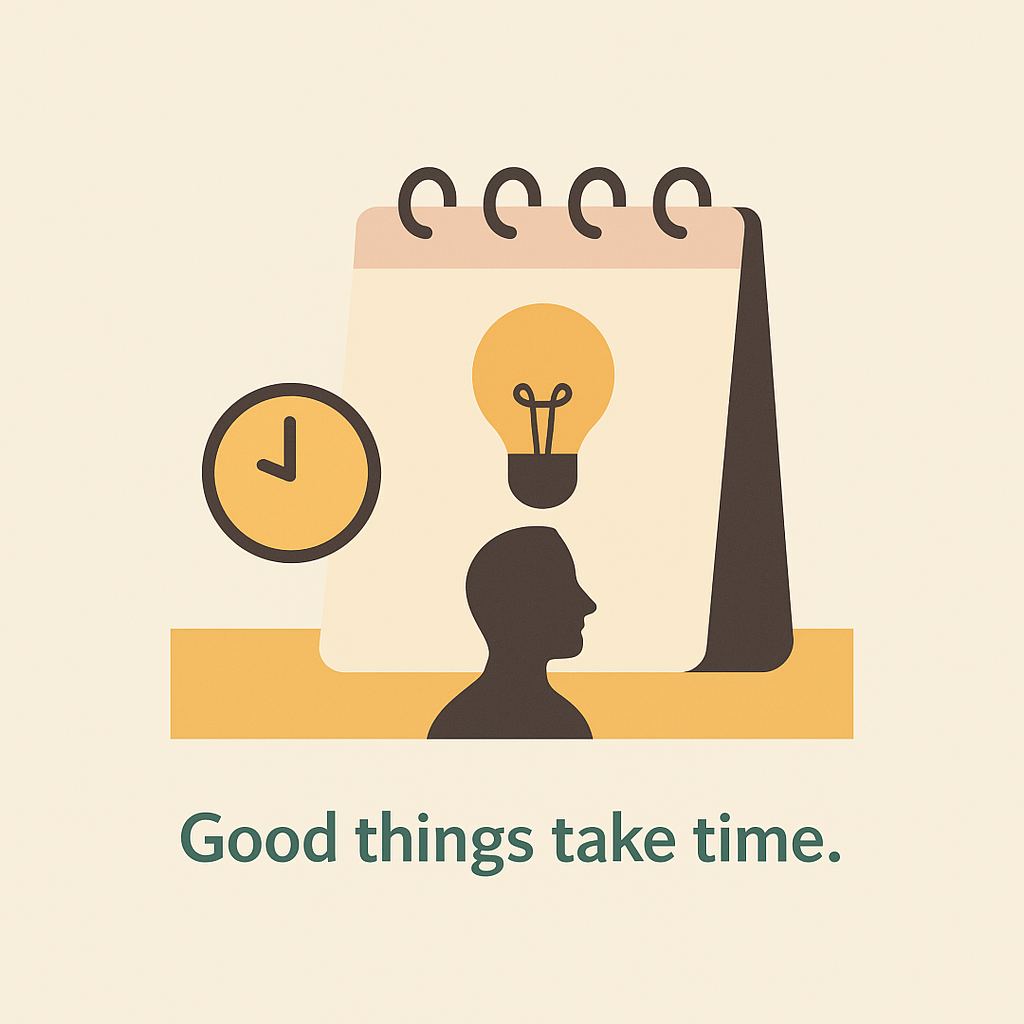
Imagine a potter at dawn, hands in cool clay. No rush, no timer ticking. Each spin of the wheel, each pause to look, shapes what will be. The world will only see the finished pot, smooth and whole. They won’t see the cracked attempts, the shelves of unfinished shapes, the quiet hours spent just staring at clay.
And yet, it is in those hours — unseen and unmeasured — where the real art lives.
In our need to hurry, we forget that nothing alive is made in haste. A tree does not bloom by deadline. A river carves stone by patience, not speed. And creativity, too, follows nature’s law: it unfolds, it deepens, it becomes — only in time.
Why We Push for Speed
The world claps for speed. Fast posts, daily updates, drafts hammered out overnight. It feels powerful to produce quickly, to watch your work multiply on the page. But what we call progress often becomes repetition. We trade depth for movement, honesty for applause.
It’s tempting to believe that creativity obeys the clock. That the right routine, the right app, the right hustle can force inspiration to appear on schedule. But the truth — the inconvenient, beautiful truth — is that ideas do not keep office hours.
The Gift of Slow Thinking
Slow thinking is not laziness. It is care. It is stepping back from the canvas not to pause, but to see what you made. It is rewriting a single sentence until it finally sounds true. It is walking away from a problem so your mind can turn it over in silence.
Orwell rewrote paragraphs until every word held weight. Dostoevsky lived through prisons of thought and memory before words reached the page. Neither hurried, though both knew deadlines and pain. They understood what most forget: that time itself is part of the craft.
The Invisible Work
To outsiders, it looks like waiting. A poet staring out a window. A designer pacing the kitchen at midnight. But under the quiet, ideas collide, break, reform. It is here, in this silence, where the shallow ideas fall away, and something deeper begins.
This waiting is work. Work without clear shape, without promise of reward. It takes faith to sit with it. Faith that something real will rise from the fog.
We Fear What Time Demands
Time makes us face what shortcuts hide. It shows us weak arguments, false notes, hollow lines. It asks for honesty, for surrender, for the courage to start again.
Many avoid this. They choose speed not because it’s better, but because it keeps doubt away. But doubt is not an enemy. It is the signal that you’ve stopped repeating yourself and started thinking.
Creativity Lives in the Mess
Great work rarely feels neat. It begins in fragments, scribbled notes, discarded drafts. A phrase on a bus ticket. A half-formed idea whispered to a friend. Over days, weeks, sometimes years, these pieces find each other. They become something new, something whole.
It is the longest part of the process, and the most vital. Without it, all you have is surface: clean lines without meaning, style without soul.
Patience Is a Kind of Bravery
To wait, to rewrite, to doubt and keep going — this is quiet bravery. It is trusting that what you’re making will matter, even if no one sees it yet. It is resisting the rush to show, to share, to finish too soon.
Patience is not absence of work. It is work of a different kind: the steady return, the willingness to throw away what isn’t right, the belief that what lasts cannot be rushed.
An Unexpected Example
Consider Harper Lee. She took years shaping To Kill a Mockingbird, rewriting until the story felt real. Or Gaudí’s Sagrada Família, still unfinished more than a century later — each stone placed slowly, deliberately. These works endure because their makers refused to hurry.
They show us that what matters isn’t how fast you finish, but how fully you create.
Final Thoughts
You can produce quickly. The world will notice. But to create something that feels alive — something that might outlive you — requires what the clock can’t give: time, doubt, patience, and the quiet bravery to keep going.
The potter knows this. The writer learns it. The artist lives it.
Because in the end, creativity isn’t what you do in haste. It’s what you make room for, slowly, until it finally becomes true.


Leave a Reply