
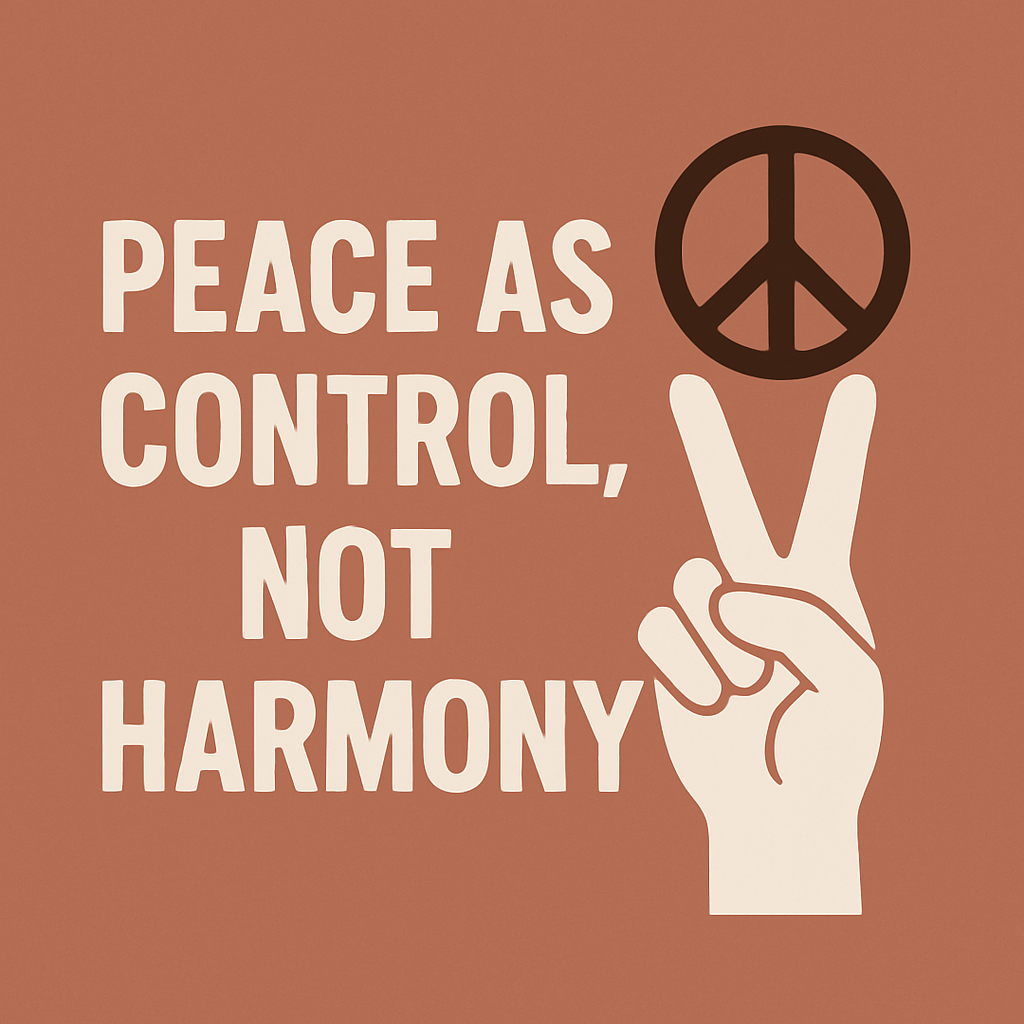
Peace sounds pure. It’s painted as the final goal of progress, the product of maturity and understanding. But what if peace is not always the end of violence, but its continuation by quieter means? What if the peace we’re taught to admire is simply a tool for keeping us still?
There is a kind of peace that grows from mutual respect, deep understanding, and hard-earned clarity. But that kind of peace is rare. Most of what we call peace is nothing more than controlled silence. It is the absence of visible chaos, not the presence of real harmony.
And yet, most people prefer it. Because it feels safe. But safety, too, can be a cage.
Manufactured Calm
Governments, corporations, institutions—even families—often want calm, not truth. Truth causes trouble. Truth questions the structure. So instead, they offer a version of peace that is easier to manage: one that tells you to sit down, be quiet, smile, and move along.
This is the peace of the workplace where everyone pretends things are fine. The peace of the classroom where no one asks why. The peace of a society where comfort is prioritized over clarity. It is the kind of peace that depends on people staying numb.
It isn’t born out of resolution. It’s maintained by suppression.
The Cost of Not Rocking the Boat
We are taught from a young age that being disruptive is bad. We’re told to be respectful, polite, cooperative. These traits aren’t bad on their own. But they become dangerous when they are used to smother awareness.
A child who questions rules is seen as difficult. A worker who questions leadership is labeled ungrateful. A citizen who questions authority is seen as a threat. In each case, peace becomes a script—and stepping outside it becomes a sin.
But silence doesn’t erase problems. It just hides them. It wraps them in smiles and small talk and euphemisms. Until eventually, people forget there was a problem at all.
Who Is the Peace For?
Not all peace is shared equally. Some people enjoy the comfort it brings, while others pay the price for it. The peace of the rich often depends on the silence of the poor. The peace of the powerful requires that the powerless don’t protest.
When someone says, “Don’t make it political,” what they often mean is, “Don’t make me uncomfortable.” When they say, “Let’s just keep the peace,” what they often mean is, “Let’s not question what benefits me.”
This is not harmony. This is hierarchy.
True Peace Looks Different
Real peace is uncomfortable. It requires us to sit with pain, not pretend it doesn’t exist. It invites difficult conversations. It demands that we ask who is being silenced so that others can feel comfortable.
It isn’t about everyone agreeing. It’s about everyone being allowed to speak. It isn’t quiet. It’s clear.
Real peace can look like protest. It can sound like resistance. It can feel like conflict—because it doesn’t mask what’s wrong, it brings it into the light.
The Fear Behind the Calm
Why are we so afraid of conflict? Why do we chase a shallow kind of peace, even when we know it’s fake?
Because real peace asks us to change. It asks us to give up control, to admit we were wrong, to listen more than we talk. And that is terrifying—especially for those in power.
So instead, we’re offered comfort without clarity. Smooth surfaces with nothing underneath. Peace without substance.
But what we ignore eventually erupts. History proves it. Controlled peace doesn’t last. When too many people are silenced for too long, the silence breaks. And when it does, it is always louder than anyone expects.
You Can’t Build Freedom on Silence
Osho once said that the more we avoid conflict, the more we create it. Avoiding tension doesn’t end tension. It traps it. It delays it. And one day, it explodes.
The goal is not to live in constant battle. The goal is not to always be fighting. But pretending there is no tension when there is—that is not peace. That is manipulation.
If peace becomes the excuse not to think, not to feel, not to question—then it is not peace at all. It’s just a more polite form of control.
The Real Choice
So the next time someone says, “Let’s keep the peace,” ask who that peace is for. Ask what it’s hiding. Ask what it’s costing. Because in a world where clarity is threatening, and comfort is currency, peace can become a prison.
You have to decide: do you want calm—or do you want truth?
Because the two don’t always live in the same room.


Leave a Reply