
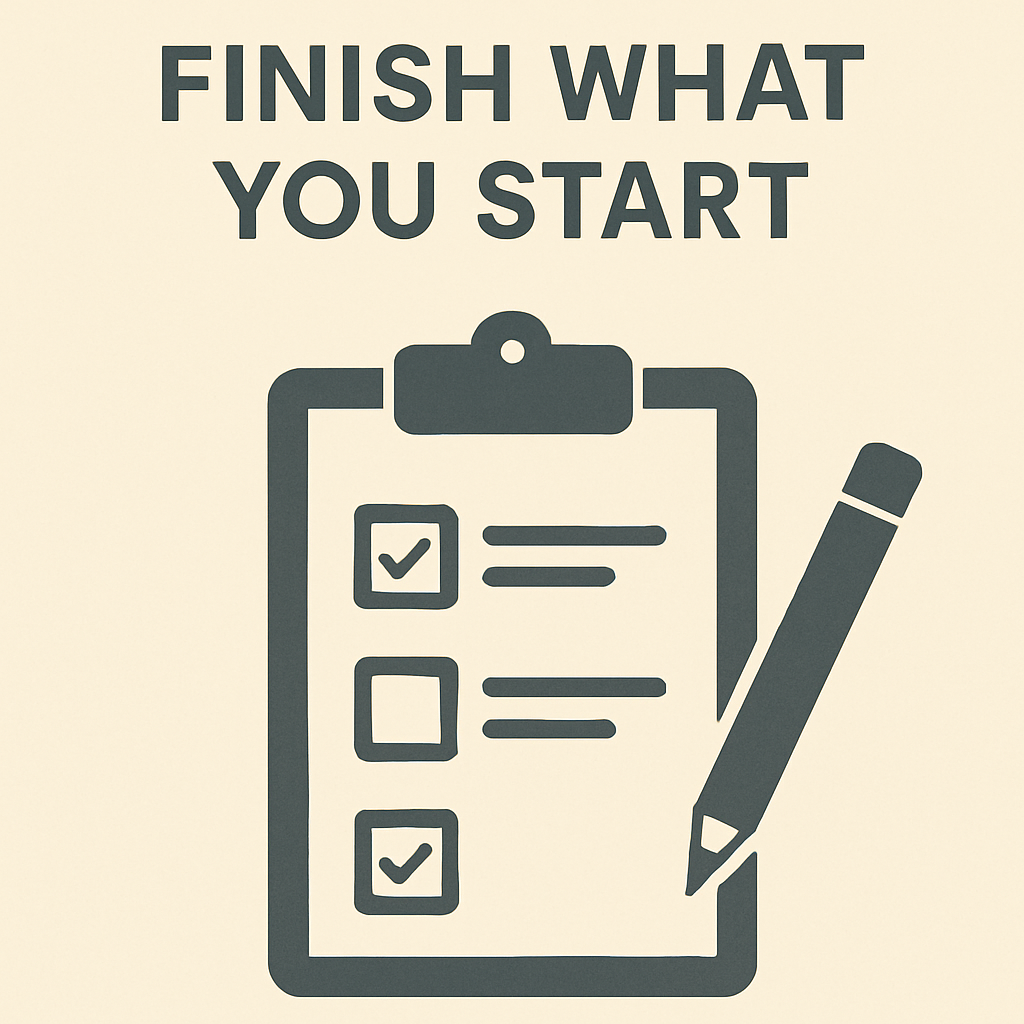
Finishing something is underrated. In a world that glorifies starting—new goals, new habits, new projects—we forget the quiet, transformative power of completion. Starting is thrilling. Finishing is grounding. And it is in the act of finishing, not beginning, that we shape how we see ourselves.
Finishing teaches you that you’re someone who follows through. It doesn’t matter if the task is monumental or modest. Making your bed. Completing a workout. Submitting a project. When you finish, you silence the part of you that doubts. You prove, again and again, that you can be trusted—by others, and more importantly, by yourself.
The Confidence Loop
Each time you finish, you cast a vote for self-belief. You train your mind to expect completion. This is the opposite of what happens when you abandon tasks. Every half-read book, half-written page, half-started habit chips away at your confidence. You begin to see yourself as someone who almosts. Who starts but doesn’t stay. Over time, that story becomes your identity.
But when you finish, the loop changes. Completion breeds confidence. Confidence breeds consistency. And consistency brings results.
Why We Struggle to Finish
We struggle to finish because finishing forces a reckoning. It invites judgment. A finished piece of writing can be critiqued. A completed task becomes real. Perfectionism thrives on avoidance. It says, “Don’t finish—not yet. It’s not good enough.” So we linger. We tweak. We stall.
But perfection is a moving target. It cannot be caught. Waiting for it only ensures delay. The goal isn’t flawless execution. The goal is honest completion. To say: “This is done. It may not be perfect, but it is whole.”
Small Finishes Lead to Big Changes
You don’t have to start with a novel or a business. Begin with what’s in front of you. Finish the book you set down. Fold the laundry you left in the basket. Send the message you’ve been rewriting in your head.
These small acts do more than tidy your day. They retrain your mind. They teach you to stop waiting, stop stalling, and stop underestimating the value of closure. You begin to shift from someone who hesitates to someone who completes.
The Psychology Behind Completion
Psychologists refer to the “Zeigarnik Effect”: unfinished tasks stick in your mind more than finished ones. They drain your focus. They pull on your energy. But when you finish, your brain gets to close the loop. It gets to rest.
That’s why completing even small things feels so good. It brings relief. It lightens the load. And that lightness gives you more energy for what matters next.
Finishing as a Form of Self-Respect
To finish is to respect the time and effort you’ve already invested. It is to honour the work. And even more, it is to honour yourself. Incomplete work lingers not just in your schedule but in your self-image. It becomes mental clutter. Emotional weight. But when you complete, you clear space—both around you and inside you.
It sends a message: I matter enough to finish what I start.
Examples That Prove the Power
Steve Jobs was notorious for demanding complete focus on products from start to launch. He believed unfinished ideas were distractions. Leonardo da Vinci, though known for masterpieces, also left behind many incomplete works—a fact that historians often cite when contrasting genius with discipline.
And consider Serena Williams. Her greatness is not just in talent but in her ability to finish. To play through fatigue. To close the match. To win when it matters.
It’s not the dreamers who rise. It’s the finishers.
How to Make Finishing Easier
Break things into parts. Set small, honest deadlines. Finish one sentence, one task, one chore. Then pause. Celebrate the small win. Let that become the proof that you can do it again.
Don’t wait for motivation. Let momentum be your guide. If you’re tired, finish small. If you’re afraid, finish imperfect. But keep finishing.
Final Thoughts
The world may never see everything you finish. And that’s fine. Because finishing is not always for the world. It’s for you. It’s the quiet act of building belief. The slow sharpening of character. The daily vote for becoming someone you trust.
So today, don’t just start. Finish something.


Leave a Reply