
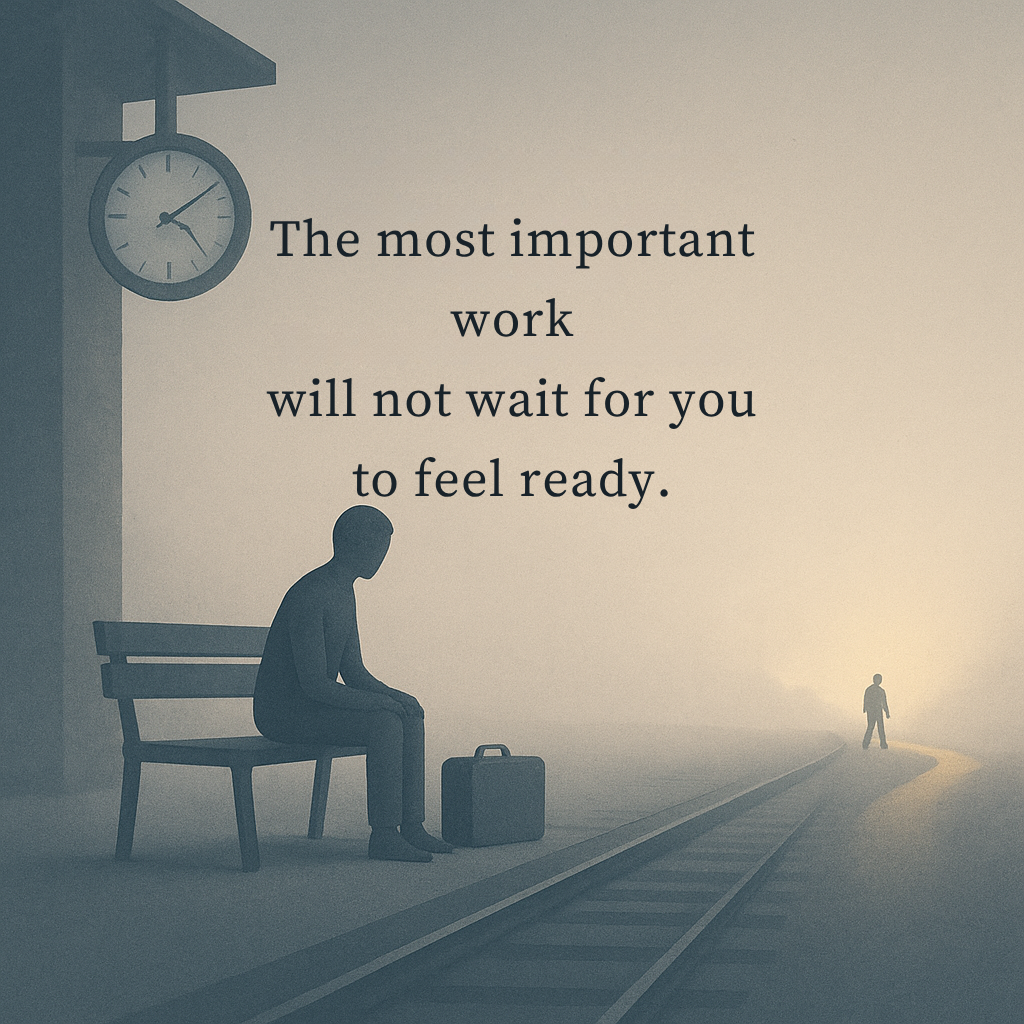
There’s a quiet myth we carry that says change begins with a feeling. We think we need to feel inspired before we act, that motivation is the gatekeeper to progress. So we wait. We wait for the burst of energy, the sudden clarity, the moment that finally feels right. But that moment rarely arrives. And if it does, it fades as quickly as it came.
Waiting for motivation is the most popular way to stay stuck. It makes inaction feel noble. It lets us say, “Not yet,” without feeling like we’ve failed. But every day we delay for the sake of feeling ready is a day we hand over to resistance. We imagine motivation will sweep in like a tide and carry us forward. But in reality, it’s a flicker—not a fire. It’s a guest, not a guide.
Emotion Is Unreliable Fuel
Our feelings were never built for consistency. They shift with the weather, with sleep, with what we ate, with one conversation. To build a life on feelings is to build on sand. When we treat motivation as our entry point, we tie progress to something that’s never promised.
The people we admire—the ones we call driven or successful—aren’t necessarily more motivated than anyone else. They’ve simply learned not to wait for it. They work when they’re tired. They show up when they’re uninspired. They don’t look inward for a signal to begin. They’ve already decided: the work matters, and it will get done.
This is not about becoming emotionless. It’s about not letting emotion rule the calendar. There is room for feeling, but not control. We are not machines. But we cannot let mood determine momentum.
Habits Work When You Don’t Feel Like It
A habit is a structure that supports you when your willpower doesn’t show up. It removes the need for daily negotiation. Instead of wondering whether today is the day you write, or run, or study—you do it because that’s what you do. No vote is taken. No committee of emotions is consulted.
You don’t rise by accident. You rise by design. You shape systems that hold you to your values, even when your feelings don’t. The person who trains on bad days gets stronger faster. The writer who types through doubt becomes fluent. The student who studies without a mood becomes consistent. Progress belongs to those who move when movement is hard.
Habits are not glamorous. They are invisible, repetitive, and often boring. But they are reliable. And reliability wins.
What Motivation Doesn’t Teach You
Motivation convinces us that progress should feel good. But many breakthroughs feel terrible. They feel like confusion, struggle, discomfort. When you rely on motivation, you expect flow. When you rely on habit, you expect resistance and show up anyway.
There’s a kind of quiet strength that forms when you work through the fog. It’s not loud. It’s not dramatic. But it’s the seed of resilience. That kind of progress rewires who you are. It tells your mind: I move even when it’s hard. I act even when I don’t feel like it. That’s how identity changes—through action, not mood.
The person who waits for motivation only learns one thing: how to wait better. The person who acts without it learns how to grow.
Your Feelings Are Not the Standard
We often assume that if something feels hard, it must be wrong. We say things like, “Maybe it’s not the right time,” or “Maybe I’m just not in the right headspace.” But there’s rarely a right time. There’s only time—and the choice to use it.
Discomfort is not a stop sign. It’s a signal that you’re stretching. That the edge is near. That you’re walking where you’ve never walked before. That’s not a reason to turn back. It’s a reason to keep going.
You are not failing because you’re tired, or uncertain, or afraid. You’re only failing if you believe those feelings matter more than the action you promised yourself.
Replace the Question
We often ask, “How can I feel motivated?” That question leads nowhere. It’s the wrong problem. The better question is, “What would I do if I didn’t need to feel motivated?” That question leads to design. It leads to routines, commitments, rituals. It forces clarity.
And clarity is more useful than inspiration. It gives you a map. Motivation only gives you a spark. Sparks are beautiful, but they don’t last. Build the fire instead.
When you stop waiting for motivation, you start building discipline. And discipline is the only form of self-respect that doesn’t depend on how your morning went.
Movement Creates Meaning
We think that feeling good leads to doing good work. But often, doing the work is what makes you feel good. Movement reshapes the mood. A single action changes the atmosphere. A morning run rewrites a tired mind. Writing one paragraph shifts the weight of the day. One step is often enough to turn everything.
Action is not a reward for the right feeling. It’s the cause of it. You move, and then the clarity comes. You act, and then the pride follows. You begin, and then the energy builds.
You don’t need motivation to change your life. You need a willingness to begin without it.
Final Thoughts
The most important work will not wait for you to feel like doing it. It will not wait for motivation to visit. It will wait until you stop waiting.
There is no perfect moment. No lightning bolt. Just the daily, imperfect act of showing up.
If you’re waiting for motivation, you’re losing time. If you stop waiting, you begin winning.
And the best part is this: once you stop waiting, you never have to wait again.


Leave a Reply