
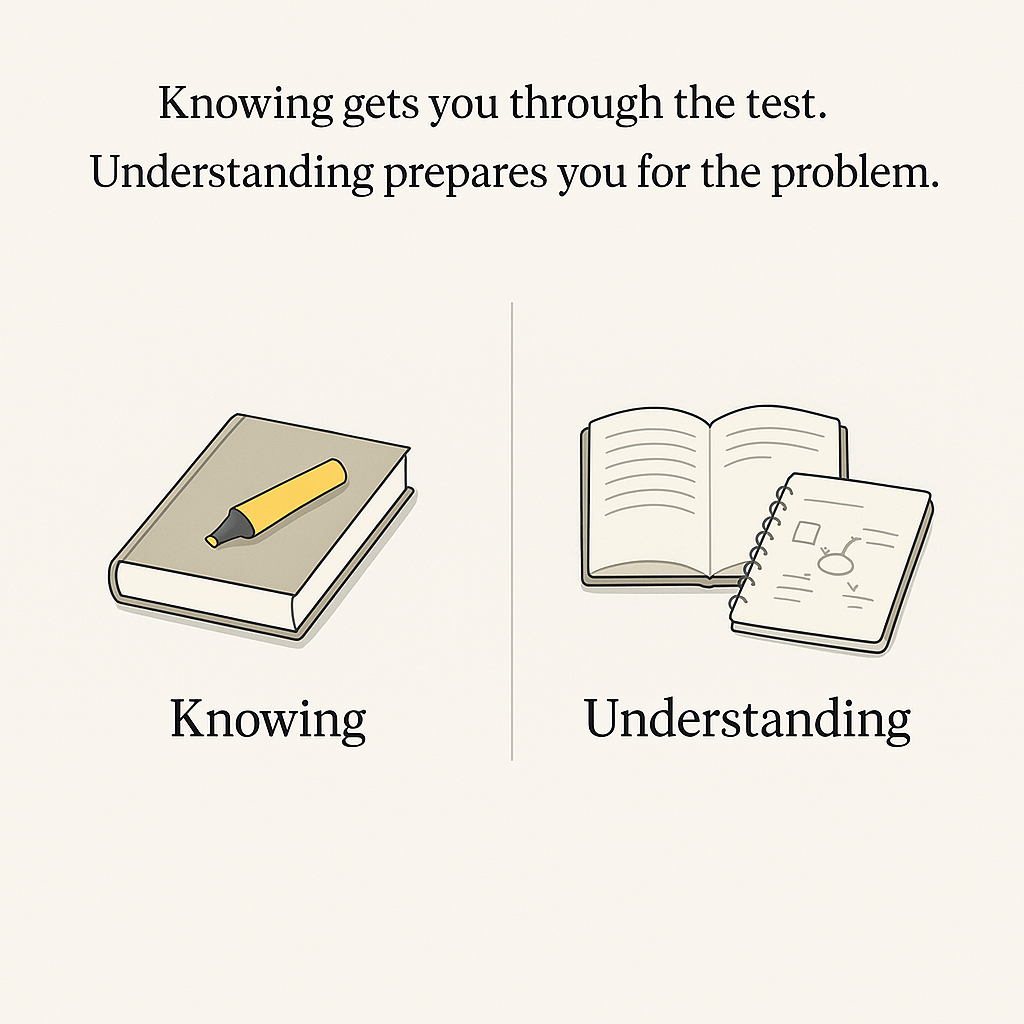
You can know something without understanding it. That’s the uncomfortable truth most students discover too late—after the test, after the assignment, after the opportunity to ask questions has passed. We often mistake familiarity for mastery. Just because you’ve heard a concept before, or seen it written in a textbook, doesn’t mean you’ve absorbed it.
Schools are built to reward knowing. Multiple choice tests, fact recall, regurgitated essays—they all favour memory. But life, real learning, and true success belong to those who understand. Understanding is the deeper layer. It’s when information turns into intuition, when facts become tools you can use rather than trivia you can repeat.
Why This Difference Matters
Knowing is passive. It’s what happens when you glance over notes or highlight a textbook. You think, “Yeah, I remember that,” and move on. Understanding is active. It’s what happens when you explain a concept to someone else and they get it. It’s when you can apply a formula in a new context, or when you can write an answer in your own words without copying.
The world outside the classroom doesn’t care how many definitions you’ve memorized. It wants to know: can you solve the problem? Can you connect the dots? Can you see what others missed? Students who learn how to move beyond knowing and into understanding become not just better learners, but more capable thinkers. And that advantage compounds over time.
How to Tell the Difference
If you want to check whether you understand something, ask yourself these three questions:
- Can I explain this to someone younger than me?
- Can I apply this idea in a situation I haven’t seen before?
- Can I spot mistakes or gaps in someone else’s explanation of it?
If the answer is no to any of those, you probably only know the material. You don’t understand it yet. That’s not a reason to panic. It’s a reason to get curious. To revisit the material, to try again, to ask better questions.
The Trap of Performance Learning
Too many students learn to “perform” for school. They cram, they memorize, they guess what might be on the test. Then they forget it all days later. That might earn you grades, but it won’t earn you growth. Understanding isn’t built in sprints. It’s built in layers, over time.
Performance learning makes you a reactive student. You study only when exams loom, you revise only what might show up. But understanding turns you into a proactive learner. You build knowledge brick by brick, and each layer supports the next. That’s the kind of learning that lasts.
Making the Shift: From Knowing to Understanding
So how do you move from surface-level knowing to deep understanding? Start by changing how you study.
- Don’t just read—write. Take notes in your own words. Summarize what you’ve learned. Try teaching it out loud.
- Use active recall. Ask yourself questions without looking at the material.
- Mix up your practice. Don’t do the same type of problem over and over. Try applying it in different formats.
- Embrace confusion. When something doesn’t make sense, dig into it. That moment of friction is where real learning begins.
It also helps to talk. Discuss ideas with classmates, explain things to siblings, join study groups. Understanding thrives in dialogue.
The Long-Term Payoff
Understanding makes you more adaptable. It helps you carry knowledge across subjects, across years, across life. A student who understands basic logic will do better in philosophy and coding. One who understands writing structure will do better in history and journalism. Understanding is what allows you to connect ideas that others see as separate.
It also makes you more confident. When you understand, you’re not dependent on the exact phrasing of a textbook or the wording of a test question. You have mental flexibility. You can adapt, reframe, respond.
And perhaps most importantly, understanding helps you enjoy learning more. There’s a real joy in clarity—in watching the puzzle click into place, in feeling the aha moment. That joy doesn’t come from cramming. It comes from connecting.
Final Thoughts
Knowing can get you through the system. Understanding can change your life. Every student has the ability to move from one to the other, but it requires a shift in mindset. Stop asking, “Have I seen this before?” and start asking, “Do I really get this?”
Because one day, you’ll be asked to solve a problem no textbook prepared you for. And in that moment, it won’t matter what you memorized. It will matter what you understand.


Leave a Reply